Quincy, St. Boniface, their children and the American record trail.
Bernard Roling worked as a cooper in Quincy, where he and Magdalena Wentz raised their family. Their story continues through weddings, working lives and family gatherings in Illinois and Missouri. The American records give us much to follow; the proposed connection to Bernard’s German household still needs a stronger link.
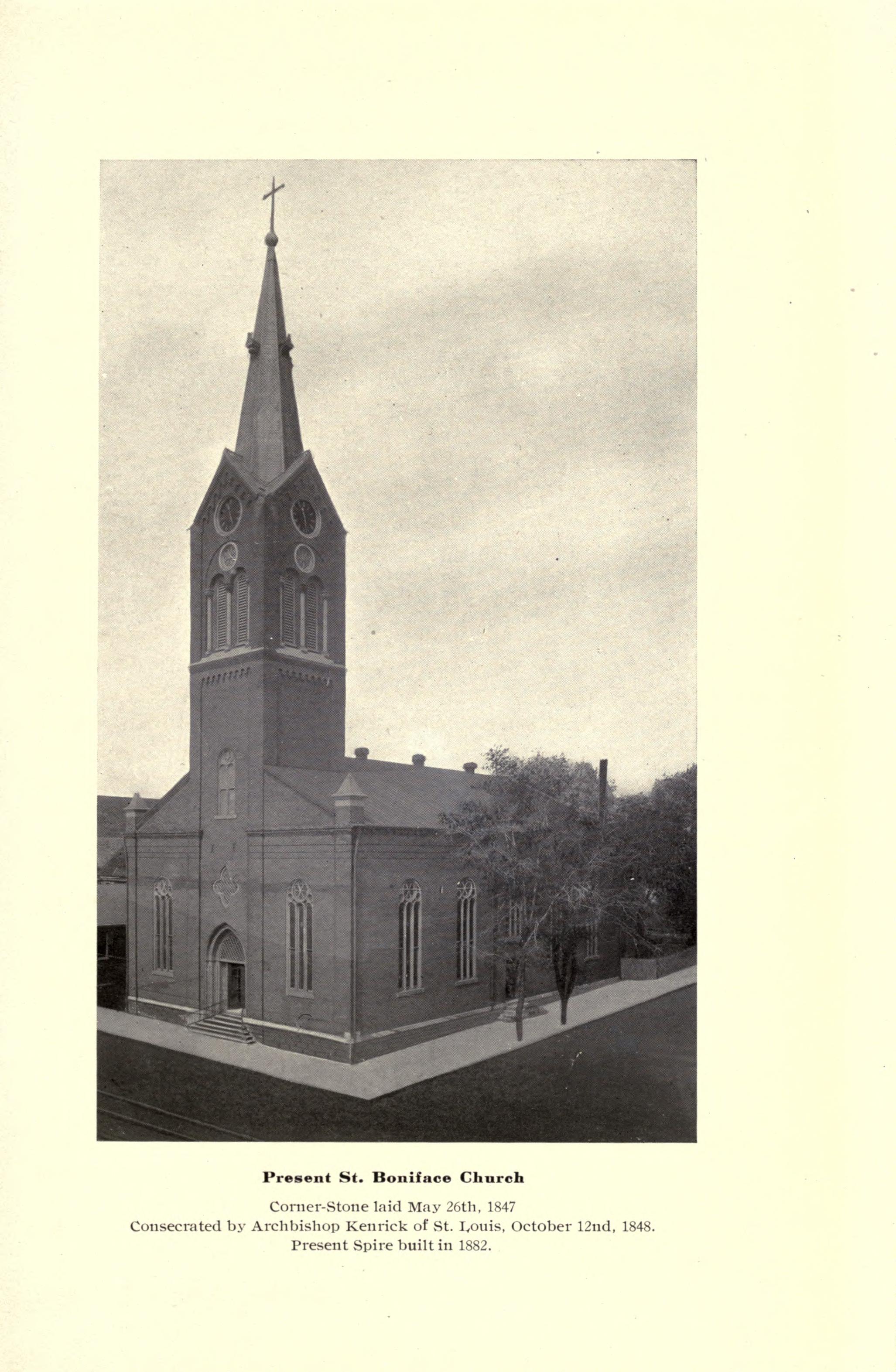
St. Boniface in Quincy
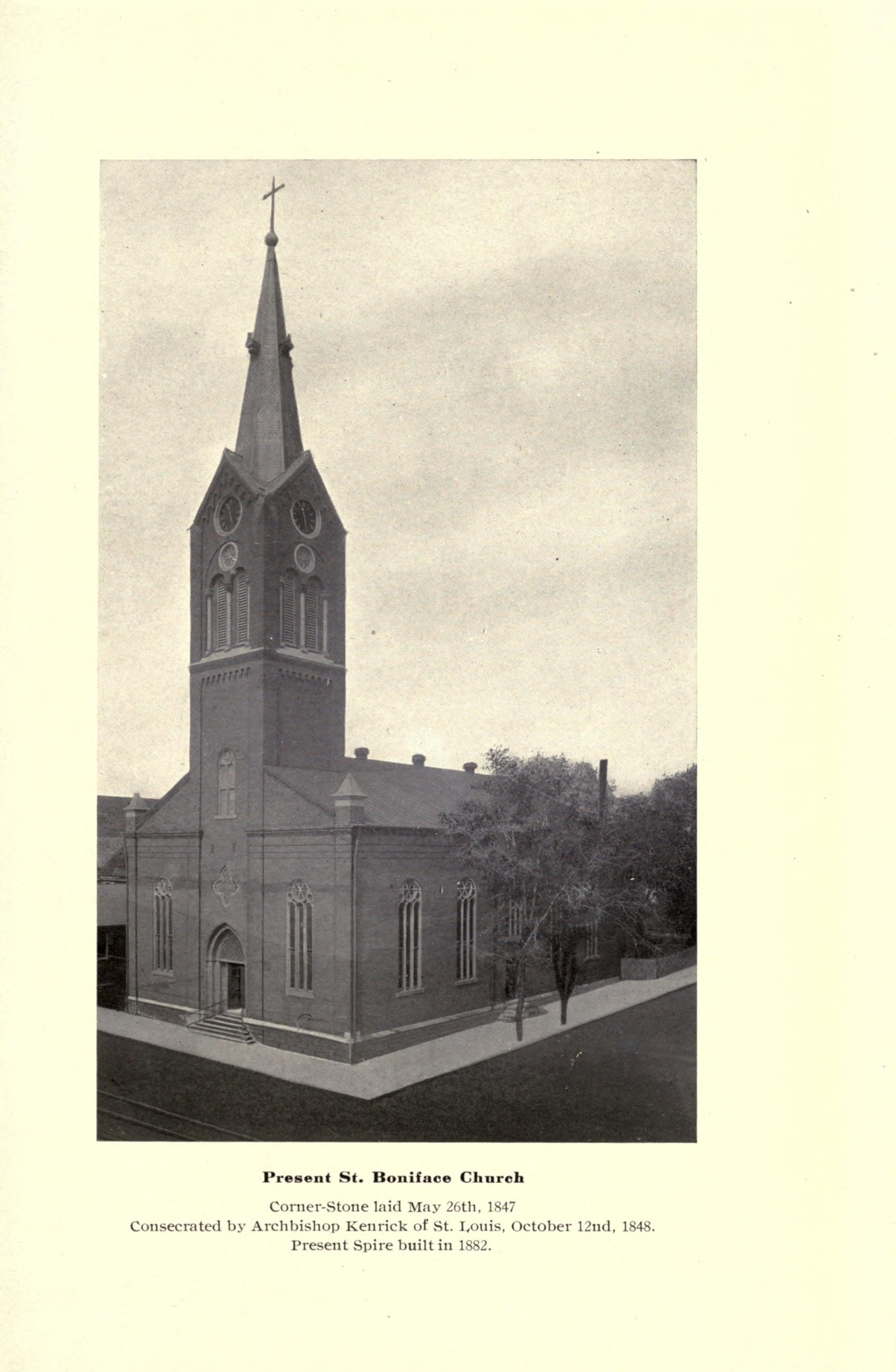
St. Boniface Congregation, Souvenir of the Diamond Jubilee (Quincy: Jost & Kiefer, [1912?]), unnumbered plate after printed page 52. Digitized by the University of Illinois Urbana-Champaign; image served by Internet Archive. Public domain in the United States.
Quincy in their early years
Quincy was a fast-growing Mississippi River city when Bernard Roling and Magdalena Wintz married in 1855. River trade connected it with the surrounding farming country, while new railroad links helped the city grow. Immigration was especially strong between 1845 and 1860. A later federal account described Germans as Quincy’s largest foreign-born group.
In 1850, Quincy was Illinois’s second-largest city by population, behind Chicago. It again held second place in 1870, with 24,052 residents. Peoria was ahead by 1880, but Quincy continued growing: 27,268 people lived there that year, and 31,494 in 1890. Growth had slowed from the earlier boom, but the city was still expanding.
Sources for Quincy’s growth and community
The 1880 census report on Quincy, published in 1887, describes the river market, new rail links and immigration between 1845 and 1860. Its description of Germans as the largest foreign-born group belongs to that later account; it is not a precise ethnic count for 1855.
The 1850 census, printed page 703, records 6,902 residents. William Vipond Pooley’s history of Illinois settlement, printed page 414, identifies Quincy as the state’s second-largest city in 1850. Later rankings and totals can be checked in the Census Bureau’s 1860, 1870, 1880 and 1890 tables. Quincy ranked third in 1860, second in 1870, and third in 1880 and 1890. These census years do not establish an exact rank for 1855.
The American records
- January 7, 1855: Bernard Roling and Magdalena Wentz married at St. Boniface in Adams County, Illinois. The diocese’s review found that the parish entry recorded neither spouse’s parents. St. Boniface marriage record; collection 61682, record 483632.
- 1859 and 1866: Published Quincy directory transcriptions identify Bernard, also listed as Barney, as a cooper (a barrel maker). 1859 directory · 1866 directory
- 1870: The original Quincy census records Bernard as a cooper born in Prussia. 1870 census record
- 1900: The Quincy census records the couple as “Rolling.” Both reported immigrating in 1854, and Bernard was marked naturalized. These are census statements; they do not identify a ship or establish the complete journey. 1900 census, sheet 12B, lines 96–97
- August 27 and 30, 1900: The Freiburg Funeral Home transcription reports Bernard’s death in Quincy on August 27 and burial at St. Boniface on August 30. The original funeral register remains desirable. Freiburg Funeral Home transcription, entry 131 in the 1900 sequence
- 1947: John Franklin Roling’s Missouri death certificate names Bernard Roling and Magdalena Wentz as his parents and reports that both were born in Germany. John Franklin Roling’s death certificate

Two citizenship records to sort out
A Bernard Roling became a U.S. citizen in Adams County, Illinois, on October 19, 1852. The original court entry names Frederick Walthaus as a witness and says the applicant had lived in the United States for at least five years and in Illinois for at least one. It gives no age, occupation, wife or address, so we still need a firm link to Bernard and Magdalena’s family.
Another Bernard Roling filed his first citizenship papers in Hamilton County, Ohio, on October 4, 1848. He was about 27, came from Prussia and said he had left Bremen on October 15, 1846, reaching New Orleans on December 26. He intended to live in Cincinnati. Those dates could fit the 1852 court entry, but neither record identifies the other. If either applicant was our Bernard, the 1900 census’s reported 1854 immigration year would need explaining. For now, these are promising leads, not a settled account of his journey.
Source notes: Adams County Circuit Court, Alien Record, volume 1, manuscript page 211, upper entry, October 19, 1852; FamilySearch DGS 007794037, full-film image 404/item image 221. The earlier declaration date and court are blank. Hamilton County Court of Common Pleas, citizenship records 1848–1851, printed page 49, October 4, 1848; DGS 005492142, image 60. The Ohio record is a declaration of intention, not final citizenship or a passenger manifest. Neither original names parents, a ship or a German hometown. Neither record establishes a connection to the Ochtrup man who married in 1850.
Their family in the records
Research note: paired births and the unresolved triplet claim.
In the 1900 Quincy census, Bernard and Magdalena reported that they had been married for 45 years. Magdalena was recorded as having borne seven children, of whom two were then living. Bernard’s obituary transcription names two surviving sons: Henry J. of Quincy and Frank J. of Salisbury. These sources do not establish the identities and life histories of all seven children.
A likely record for their daughter Elisabeth
Bernard and Magdalena’s daughter Elisabeth was born on August 28, 1855, and baptized at St. Boniface the following day. In the same parish, an Elisabetha Rolling died on November 28, 1857, and was buried the next day. She was two years and three months old, exactly the age their daughter would have been. She is very likely the same child, although the death entry does not name her parents.
A handwritten note in the family binder gives November 27, 1858 instead. For now, the original church record is the better guide, with the difference in dates kept in the notes.
Sources and notes
St. Boniface Catholic Church, Quincy, Illinois: baptism register, manuscript page 109, entry 96, August 29, 1855; and death and burial register, manuscript page 147, entry 109, under 1857. Ancestry collection 61682; access may require a subscription. The baptism names Bernard Roling and Magdalena, born Wintz, as Elisabeth’s parents. The later death entry does not name parents. The binder note does not identify a separate death record.